
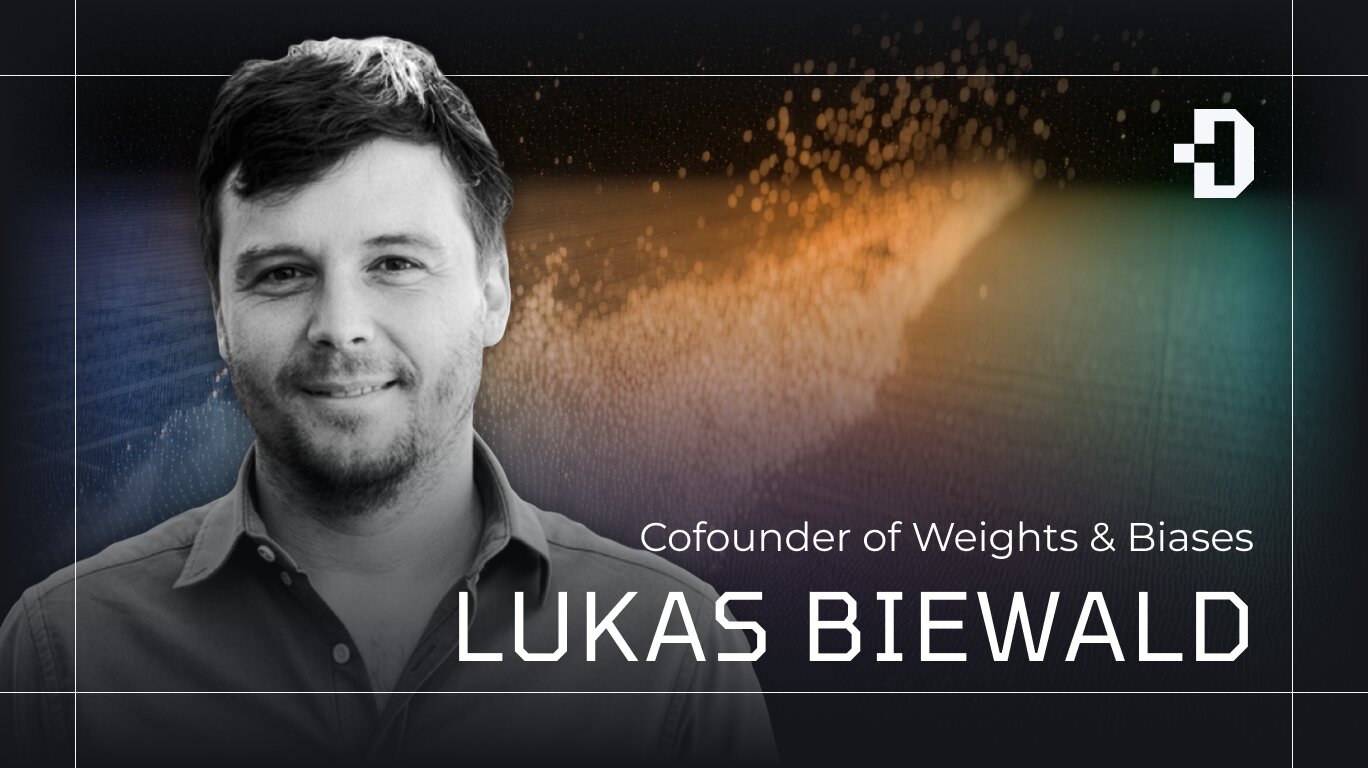
How the Weights & Biases Cofounder Created One of AI's Defining Exits



In the early 2000s, a young Stanford grad sat in a computer lab for two days watching a program teach itself to crush humans at Othello. No prior knowledge. No hand-tuned weights. Just iteration, feedback, and time.
That moment planted a seed in Lukas Biewald that would take two decades to fully bloom. First through CrowdFlower, a data labeling company that was too early for its market. Then through Weights & Biases, the ML experiment tracking platform that became the system of record for an entire generation of AI practitioners, and sold to CoreWeave last year in one of the defining acquisitions in AI infrastructure. And now, something new entirely.
Why Selling to Software Engineers Was the Best Idea Everyone Said Was Terrible
CrowdFlower taught Lukas a brutal lesson about timing. The data labeling platform he built in the late 2000s was genuinely useful. It had real customers. It was technically ahead of its time. And the board hated it.
The market seemed too small to our board and investors. So we were constantly trying to pivot out of it into other domains. But that was the thing that really worked.
Scale AI came along a few years later, leaned hard into labeling for research, and became one of the most valuable AI companies in the world. Lukas watched it happen from a front-row seat.
When he started Weights & Biases, he applied everything he had learned. He had watched the GitHub founders up close at Powerset. He had seen how people dismissed developer tools as niche, saying there weren't enough engineers, they were bad buyers, the market was too small.
Making the software engineers happy is gonna be a good business. And maybe they can't buy things now, but their boss is gonna choose to buy the things that they want to use.
Weights & Biases grew exactly the way he predicted. Not in a blaze of press releases or a single viral moment. A percent or two of active users every week, compounding quietly while the board kept asking why he was showing them charts with 30 users on them. But, he kept showing them anyway.
The System of Record Nobody Thought They Needed
The core insight behind Weights & Biases was deceptively simple. When you build AI systems, a lot of the important artifacts aren't in the code. They're in the experiments you run, the parameters you tried, the runs that failed and why. None of that had a home.
Lukas saw what GitHub had done for software and asked an obvious question nobody else was asking: where is the GitHub for AI?
I thought we could be the system of record for people building AI.
The product grew into exactly that. And when CoreWeave came calling, the logic of the combination made sense in ways that went beyond the balance sheet. Weights & Biases was sitting on passive visibility into how inefficiently people were using their hardware. Get closer to the hardware, and you could build products that nobody else could.
The cultural fit surprised even Lukas, who admits he came in skeptical of a company with roots in blockchain. What he found instead was a team that stayed up nights and weekends to keep customers happy, the same obsessive customer orientation that had defined Weights & Biases from the beginning.
The Part Where He Starts Optimizing Kernels at Midnight
Here is where the story takes a turn that even Lukas seems mildly surprised by.
He is now, personally, hands on keyboard, building a system to optimize inference services across the models CoreWeave runs. He takes a model like Qwen3, sets up a fast query loop, runs five minutes of load testing, measures throughput, and lets agents iterate on the configuration. Each experiment takes about ten minutes. He saves the results to files and looks at the graphs.
The results: 20 to 30% throughput improvements on vanilla setups.
If it's actually the AI time instead of our engineers time, I think that becomes a lot more feasible.
The observation underneath this is significant. When the cost of trying something drops to near zero, specialization becomes viable at scales it never was before. One kernel optimized for one customer's workload, one specific GPU topology, one particular mix of query types. Things that would have required months of engineering work now happen overnight.
The same logic he had applied to labeling data in 2008, to experiment tracking in 2018, he is now applying to the compute layer itself. Let a thousand flowers bloom. Optimize everything for everything.
Incrementalism Wearing a Step Function's Clothes
Lukas has a take on AI progress that cuts against the prevailing mythology.
The history of AI is like incremental improvements that we tell ourselves are these step function changes and we experience that way.
He is not being dismissive. He felt the December inflection point the same way everyone else did. His point is more precise: the experience of suddenly crossing a threshold where something works for a task you care about feels like a step function even when the underlying curve is smooth. One day the Othello program couldn't beat you. Two days later, it crushed you. Nothing discontinuous happened. Just enough iterations stacked up.
That framing matters for how you think about what comes next. If it is truly incremental, then the people who compound the fastest will keep winning. Which is why his advice to founders isn't careful or hedged.
The Advice He Wishes Someone Had Given Him
I think it's an amazing time to start a company. In times of turmoil, startups have a huge advantage over incumbents.
The analogy he reaches for is familiar but deployed with specificity. Software eating the world gave technical founders the ability to walk into any vertical and win if they were competent. AI does that again, but removes one of the last remaining constraints.
It used to be like you needed to have one industry expert and one technical founder. Now it seems like you can just have a totally technical team and go in and win.
Medicine. Law. Industrial hardware. Fields that felt protected by the expertise required to even understand them. That protection is evaporating, and the founders who move fastest will build the next generation of companies in those spaces before the incumbents understand what happened.
.jpg)
.svg)

Ready for faster dashboards?
Try for free today.